The challenge
Jensen-Sundquist did what a careful agency does before committing to anything: they shopped. Over six months they demoed and trialed one insurance technology platform after another. Software was never the shortage. Every vendor arrived with a finished product and a confident story.
None of them started with the agency's own work. Independent agencies live inside documents. Renewals get read line by line. Endorsements arrive as carrier codes that need decoding before anyone can explain them. Coverage differences between two quotes have to become something a client can decide on. And the agency's institutional knowledge, the carrier manuals, coverage guides, and internal procedures, mostly lives in binders or in the heads of whoever has been there longest.
The exposure behind that work is well documented. The IIABA's E&O Happens program puts the cost of defending and settling an agent E&O claim at $50,000 to $150,000. Every renewal read too quickly is a small bet against that figure.
So the real question was never which platform had the longest feature list. It was whether any vendor would start from what the agency actually needed.
The solution
We started by asking. In Liz Shultz's words: "Instead of telling us what their product could do, they asked what our agency needed."
That set the pattern. Their feedback went straight into the build, and the ideas they raised became features rather than roadmap items. Because we were reading their workflow instead of selling against it, we could also point at friction they had long since accepted as permanent. That is what Liz means by "solutions to problems we didn't even realize could be solved."
What came out of it is ProducerHQ, the AI workspace for independent P&C agencies. It is a finished product any agency can buy today, but its shape came from this engagement: an agency telling us, file by file, where the work actually hurts.
The distinction that matters to them is simple. They did not buy software and adapt to it. They got a development partner, and the platform still changes when they say it should.
AI architecture
ProducerHQ reads the documents an agency already has: dec pages, policy booklets, quotes, ACORD forms, contracts, claim denials, and the agency's own carrier manuals. PDFs go to the model as native document blocks so layout survives. On an ACORD form, meaning lives in which box is checked and which section a line sits in, and that does not survive being flattened to text.
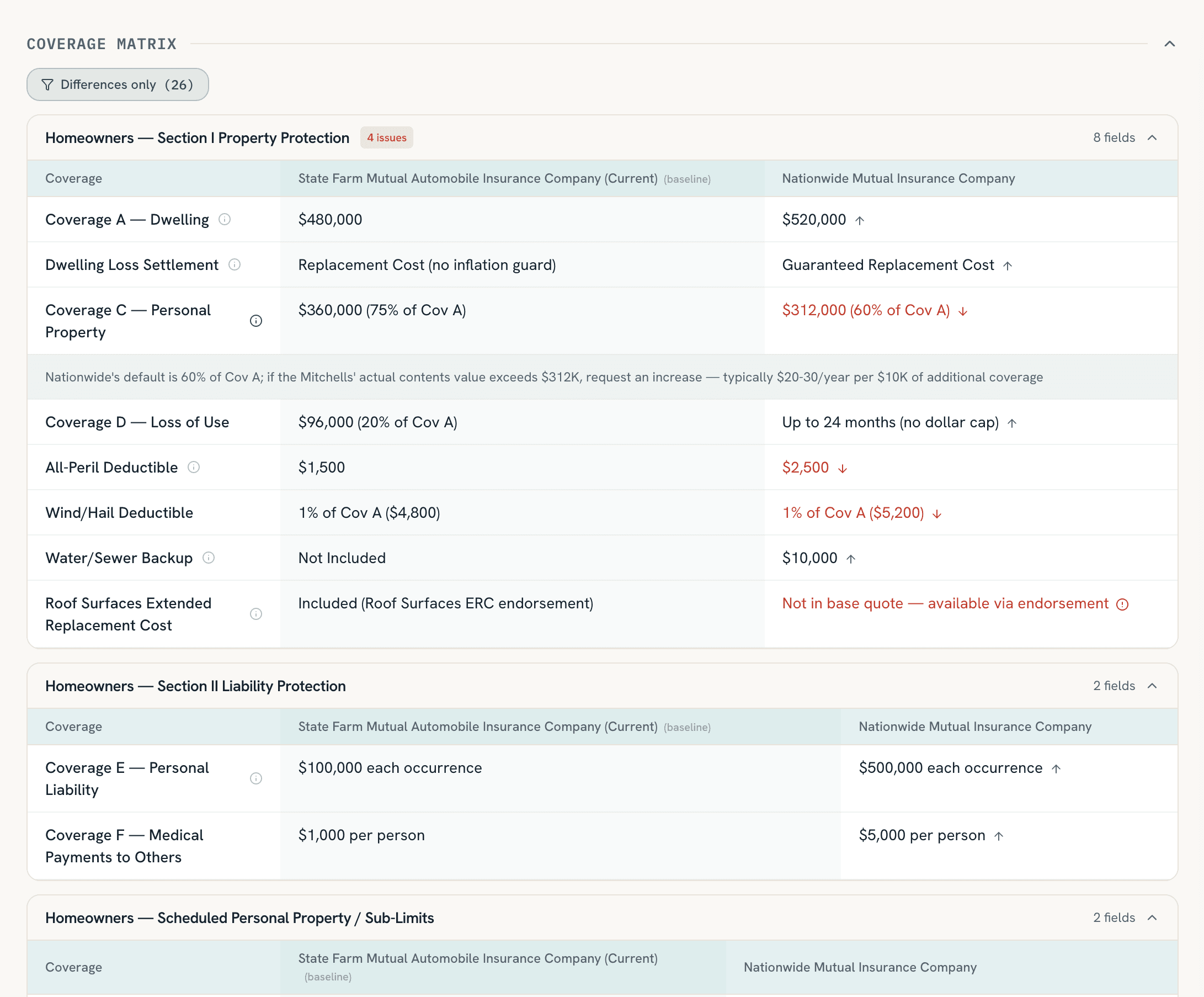
Comparison runs in stages. Each document is first read into a structured inventory: the declarations, the full forms and endorsements schedule, and the exclusions in body text, each entry with a verbatim quote and a page anchor. The differences between inventories are then computed in code, not inferred: set difference across the form schedules, value and basis comparison, premium arithmetic. Only then does a model reason over the result against a checklist of several hundred per-line-of-business checks, with a final pass hunting for anything the first one missed.
The order is the point. A form on one schedule and absent from the other is caught by arithmetic rather than attention, so it cannot be crowded out by document length. Every checklist item must come back with a verdict, and an item the model leaves unanswered is recorded as undetermined by the code rather than quietly disappearing.
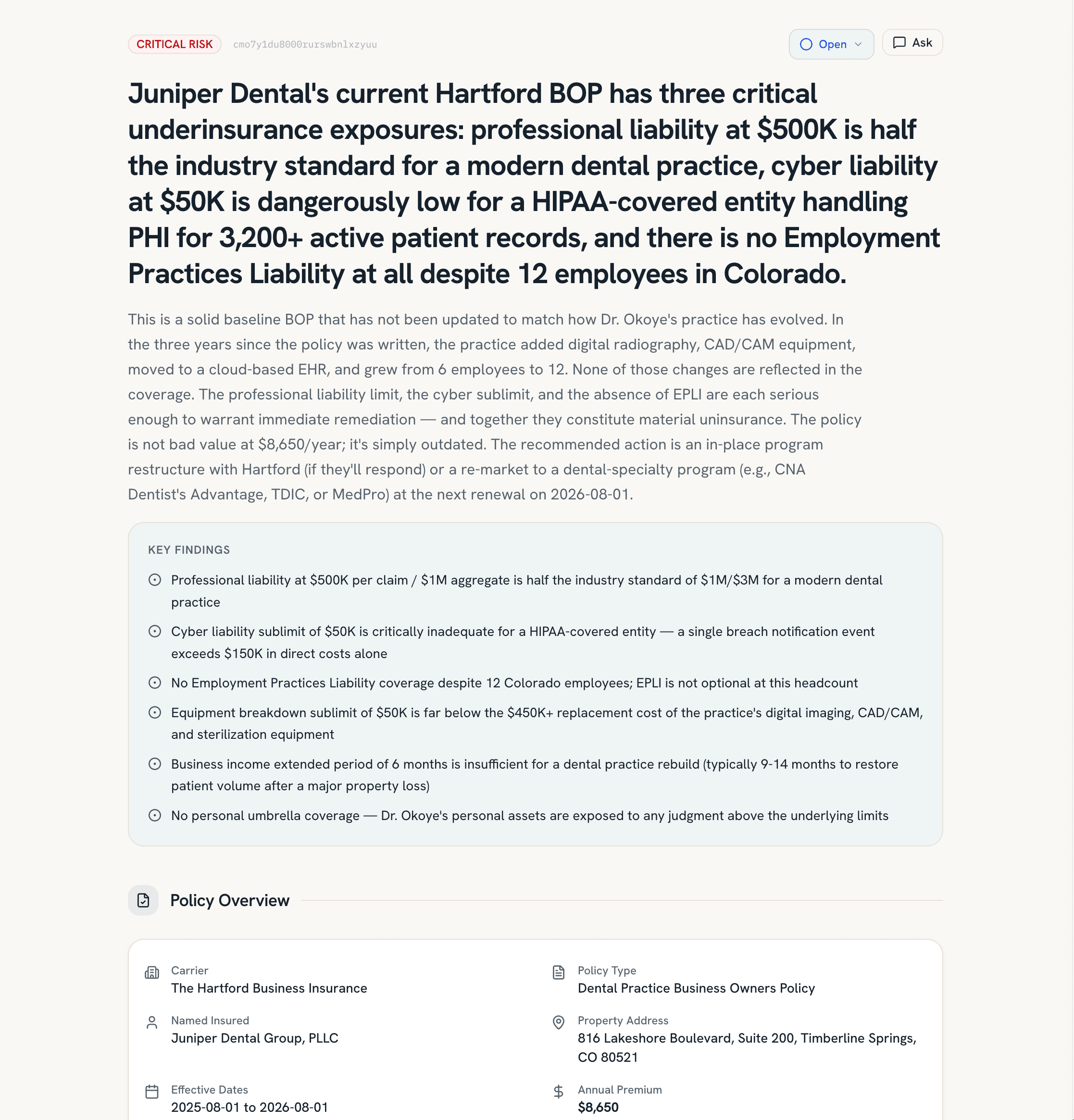
Two modules carried most of the weight here. Policy Review compares policies and renewals: it identifies coverage differences, values endorsements, and turns the findings into talking points a producer can take into a client call. Ask Assistant makes the agency's own knowledge searchable: carrier manuals, underwriting guides, and internal procedures go into a private environment, and agents get instant answers cited back to the source document.
The guardrails hold in every module. Every finding quotes the governing policy language and names its source, so anyone can check a conclusion against the page it rests on. The analysis arms a licensed agent's judgment rather than replacing it, and the carrier always makes the final coverage determination.
Documents stay in the agency's own storage and are never used to train AI models. Every analysis is timestamped and archived as it runs, so E&O documentation is produced during the work instead of reconstructed years later.
The results
The clearest account of what changed is the client's own. On Policy Review, Liz Shultz writes that it "dramatically simplified comparing policies and renewals by identifying coverage differences, valuing endorsements, reducing E&O exposure and creating customer-ready talking points in minutes."
She calls Ask Assistant "an invaluable resource": agents upload the agency's carrier manuals, underwriting guides, and procedures into a private environment and get "instant, source-cited answers from our own documents." Knowledge that lived in binders and individual memories is now something any agent can query.
The platform kept widening from there. Denial Analyzer, Contract Compliance, Cross-Sell, Pre-Claim Check, Book Analytics, and the Renewal Pipeline are all named in her review, and her verdict is that they "aren't just impressive, they solve real-world challenges that independent agencies face every day."
And this comes from an agency that had genuinely done the shopping. After six months of demos and trials across the category: "OpSpring has been unlike any other."
What it looks like